
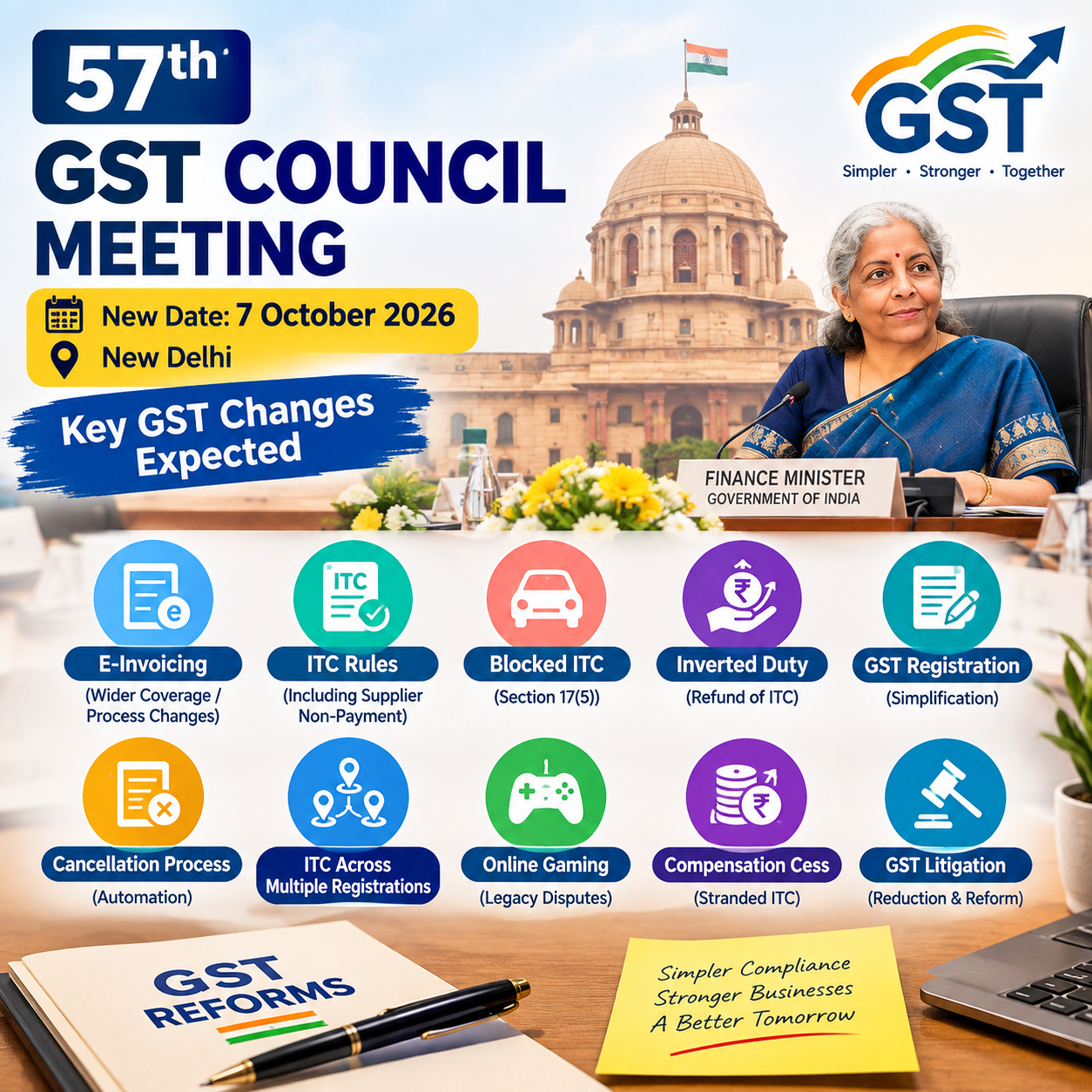

57th GST Council Meeting: New Schedule and Important GST Changes Expected
The 57th GST Council meeting, which was originally planned for 12 September 2026, has now been rescheduled to 7 October 2026 in New Delhi. The earlier date coincided with the BRICS Leaderan
s’ Summit scheduled to take place in New Delhi on 12–13 September.
The October meeting is expected to be significant as the Council may discuss several GST process and compliance reforms following the major GST rate rationalisation carried out in 2025.
Finance Minister Nirmala Sitharaman has indicated that the meeting is likely to consider process-related reforms, including e-invoicing and input tax credit (ITC) provisions. The government has also sought suggestions from industry stakeholders and tax professionals regarding provisions that may be causing unnecessary complexity or inconsistencies.
However, taxpayers should keep one important point in mind:
Issues being discussed or proposed before the GST Council are not changes in law unless they are subsequently implemented through the required legal, notification or rule-making process.
ITC When the Supplier Fails to Pay Tax — Section 16(2)(c)
One of the key concerns under discussion is the difficulty faced by a genuine purchaser when the supplier does not pay the applicable GST to the Government.
Under the existing provisions of Section 16(2)(c), payment of the tax charged on a supply to the Government is one of the conditions associated with claiming ITC, subject to the applicable statutory framework.
This can create difficulties for a bona fide recipient who has:
- received the goods or services;
- obtained a valid tax invoice;
- made payment to the supplier;
- fulfilled the other applicable ITC requirements;
but the supplier has subsequently failed to properly report or deposit the tax.
Industry representatives have therefore been seeking a mechanism that could protect a bona fide buyer from losing legitimate ITC solely because of a supplier’s default. This issue has been highlighted in discussions and reports ahead of the Council meeting.
Review of Blocked ITC Under Section 17(5)
Another major area of discussion is blocked input tax credit under Section 17(5).
The current provision restricts ITC on certain specified goods and services, subject to prescribed exceptions. These include areas such as certain motor vehicles, food and beverages, health-related services, club memberships and other specified categories.
Industry stakeholders have been requesting a review of some of these restrictions.
Although motor vehicle-related ITC provisions may come up for discussion, taxpayers should not assume that ITC will automatically become available after 7 October. Any change would require the appropriate legal process following a Council recommendation.
Inverted Duty Structure and Refund of Accumulated ITC
The inverted duty structure is another important issue that may receive attention.
An inverted duty situation arises when the GST rate applicable to inputs is higher than the GST rate on the final outward supply. This can result in the accumulation of ITC and create a working-capital burden for businesses.
Industry has been requesting changes to the refund mechanism and treatment of accumulated ITC.
Reports ahead of the meeting have identified refund-related provisions and inverted-duty issues among the matters that could potentially be considered.
This issue can be particularly important for businesses where:
GST on Inputs > GST on Outward Supplies
resulting in a continuous accumulation of unused credit.
GST Registration Process — Proposed Simplification
GST registration is another significant area forming part of the broader process-reform discussion.
Businesses have raised concerns regarding:
- repeated submission of documents;
- differences in requirements between jurisdictions;
- physical verification procedures;
- delays in registration;
- difficulties in cancellation;
- additional scrutiny faced by genuine businesses.
The Government has also been working towards a more standardised registration mechanism for larger businesses, particularly businesses having monthly ITC exceeding ₹2.5 lakh.
Simplification of GST Cancellation
The GST registration cancellation process is also expected to be considered as part of the broader reform exercise.
The objective of such reforms would be to make registration and cancellation procedures more streamlined and automated, helping genuine taxpayers avoid unnecessary procedural delays.
E-Invoicing — Possible Expansion and Process Reforms
E-invoicing is another important subject because the Finance Minister has specifically referred to it as part of the GST process-reform agenda for the October meeting.
There has been discussion regarding the possibility of extending e-invoicing to a broader group of taxpayers, including consideration of its applicability to composition taxpayers.
The GST Council may therefore examine further expansion of the e-invoicing framework along with related procedural improvements.
Utilisation of ITC Across Multiple GST Registrations
Another issue that has attracted industry attention is the treatment of unused ITC across different GST registrations of the same business.
For instance, a company may have GST registrations in:
Delhi | Haryana | Maharashtra | Punjab
It may have significant unused ITC under one registration while another registration has an output tax liability.
Under the existing GST framework, the electronic credit ledger of one State registration cannot simply be transferred to another State registration.
Industry has therefore been seeking possible mechanisms to deal with stranded or unutilised ITC across multiple registrations.
Greater flexibility in the utilisation of surplus ITC has been identified in reports as one of the issues that could be considered by the Council.
Online Gaming — Resolution of Legacy GST Issues
Online gaming is another area involving significant legacy disputes and litigation.
Industry stakeholders have been seeking possible solutions for legacy tax issues and ongoing disputes relating to the earlier GST treatment of online gaming.
Reports ahead of the meeting have identified the regularisation of legacy positions in the online gaming sector as one of the concerns that industry may place before the GST Council.
Key Takeaway for Taxpayers
The 57th GST Council meeting on 7 October 2026 could bring discussions on several important GST process reforms, including ITC rules, blocked credits, inverted-duty refunds, registration and cancellation, e-invoicing, cross-registration ITC utilisation and legacy online gaming issues.
However, taxpayers should distinguish between industry representations, proposals and Council discussions and actual changes in GST law.
Any proposal will become applicable only after the necessary recommendation, notification, amendment or rule-making process is completed.
“The GST Council may consider ways to resolve or regularise legacy disputes and pending litigation related to the online gaming sector.”
Compensation Cess — Issue of Stranded ITC
Another significant issue emerging after the GST rate rationalisation is the treatment of unused input tax credit related to compensation cess.
Industry stakeholders have raised concerns regarding compensation cess credit that remains embedded in existing inventory, particularly in sectors such as automobiles.
According to reporting by The Indian Express, automobile dealers have accumulated considerable ITC associated with the now-discontinued compensation cess and are seeking clarity on how this credit should be treated.
The issue is therefore particularly relevant to:
Automobile Dealers + Tobacco Businesses + Other Sectors Affected by the Transition from Compensation Cess
“The treatment of unutilised compensation-cess credit remains an important issue that industry expects the GST Council to examine.”
Another Key Issue: GST Litigation
The October meeting is increasingly being viewed as a process-reform-focused meeting, with reducing unnecessary GST litigation forming an important part of the broader reform agenda.
Finance Minister Nirmala Sitharaman has invited industry stakeholders and professionals to highlight GST provisions that may be creating unnecessary complexity, inconsistencies or anomalies.
The objective is to identify areas where procedural improvements or clarification could make GST compliance simpler and potentially reduce avoidable disputes and litigation.